In this Article
Leatherwood honey and Manuka honey are both celebrated for their unique properties, but they come from vastly different landscapes and traditions. Discover how Tasmania's rare rainforest honey compares to the world's most famous medicinal honey, from flavour and origin to the naturally occurring compounds that make each one special.
Written by

Deborah Freudenmann
Products Related
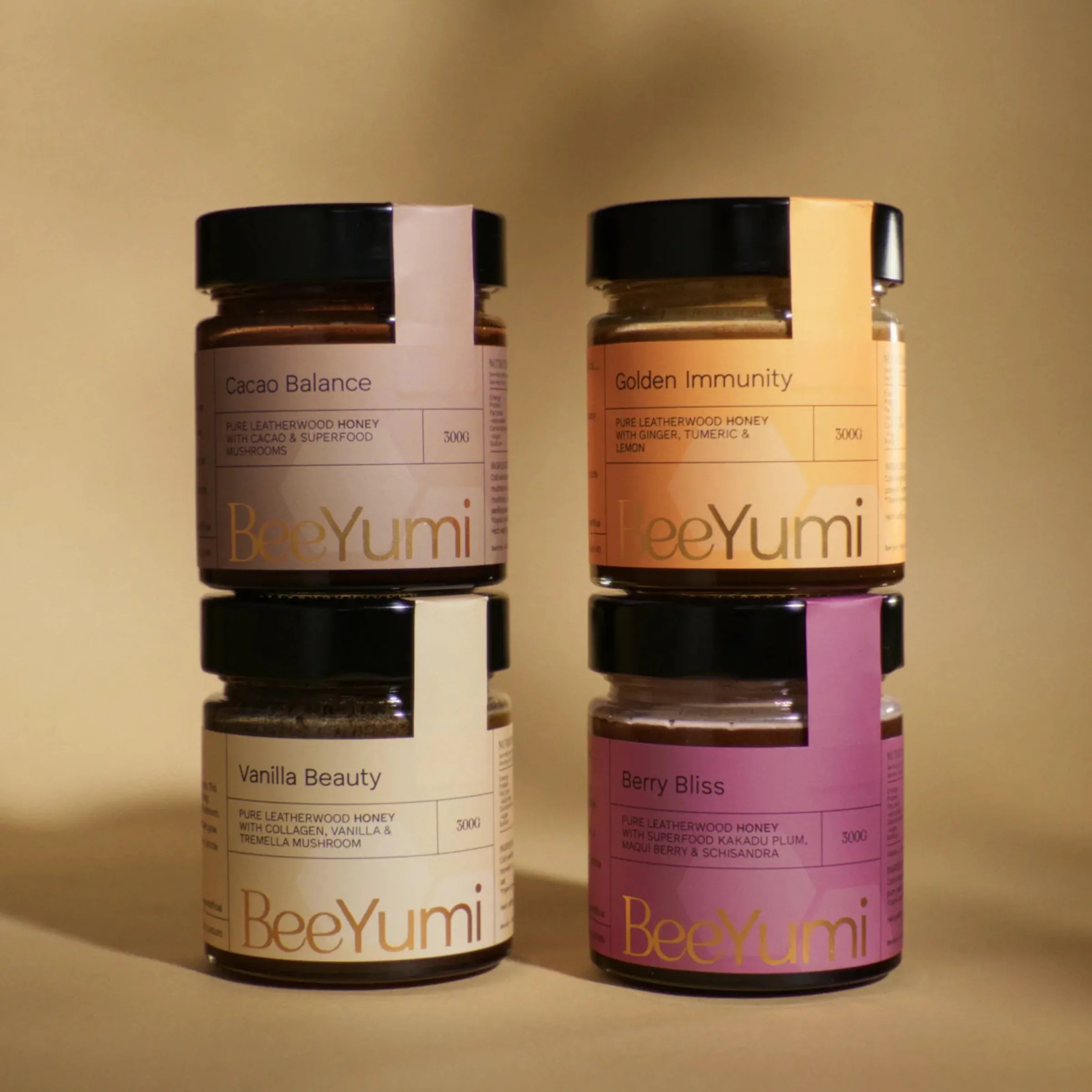
The Core Four
Our signature blends, crafted to support balance, energy, and daily nourishment.
Honey & Ingredients
|
Two extraordinary honeys, two very different stories.
If you've spent any time looking into specialty honeys, you've probably come across Manuka honey. For many people, it is the benchmark against which all other medicinal honey is measured.
Then they discover Leatherwood honey and immediately ask the same question:
How does it compare?
The truth is that Leatherwood honey and Manuka honey are both remarkable, but for very different reasons. While they are often placed side by side, they come from completely different plants, landscapes, and traditions.
Understanding those differences helps explain why we fell in love with Tasmanian Leatherwood honey in the first place.
Two honeys from two very different worlds
Manuka honey comes from the Manuka shrub, which grows throughout New Zealand and parts of Australia. It has become famous for its naturally occurring methylglyoxal (MGO) content and is now produced on a large commercial scale to meet global demand.
Leatherwood honey, on the other hand, comes from the Leatherwood tree, a species native only to Tasmania.
Unlike Manuka, Leatherwood cannot simply be planted into large plantations and scaled up. The trees grow naturally within Tasmania's ancient temperate rainforests and only flower for a short period each year. The locations are remote, the harvest season is brief, and every crop depends entirely on nature.
In many ways, Manuka is cultivated and mass produced.
Leatherwood is collected from the wild.
That difference alone makes the story of Leatherwood honey incredibly unique.
A product of an ancient rainforest
One of the things that fascinated us most about Leatherwood honey was not simply its flavour or nutritional profile, but where it comes from.
The Leatherwood tree is part of an ancient lineage of rainforest plants that has survived in Tasmania for millions of years. Many of the forests where Leatherwood grows remain largely untouched, creating an environment unlike anywhere else in the world.
Every jar of Leatherwood honey begins with bees foraging among these rainforest blossoms.
That connection to place is something we value deeply.
When people talk about terroir in wine, they are referring to the influence of landscape, climate, soil, and environment. Honey has its own version of terroir, and Leatherwood's story is inseparable from Tasmania's wild rainforest ecosystem.
What about the health benefits?
Manuka honey has been considered the gold standard when it comes to medicinal honey. It is the honey most people think of when they hear terms like "functional honey" or "healing honey," largely due to its naturally occurring methylglyoxal (MGO) content and the significant amount of scientific research surrounding it.
And rightly so. Manuka is an amazing honey.
But in recent years, researchers have begun paying closer attention to Tasmanian Leatherwood honey.
Research has identified a diverse range of naturally occurring compounds within Leatherwood honey, including antioxidants, phenolic compounds, and a particularly interesting compound known as 4-methoxymandelic acid (4-MMA), which is unique to Leatherwood honey.
Research suggests 4-MMA possesses potent antioxidant and protective properties, helping protect cells from oxidative stress and free radical damage. But 4-MMA isn't the only thing special about Leatherwood.
Scientists have also identified a variety of other naturally occurring compounds within Leatherwood honey, including:
Ellagic acid - known for its antioxidant, anti-inflammatory, and protective properties.
Genistin - a naturally occurring plant compound that has attracted interest for its potential role in bone, cardiovascular, and hormonal health.
Methyl syringate - a powerful antioxidant compound that researchers are exploring for its role in metabolic health and blood sugar regulation.
Kojic acid - known for its antimicrobial properties and long history of use in skin health.
Abscisic acid - a fascinating plant compound that has been investigated for its role in glucose metabolism and cardiovascular health.
Lumichrome - a naturally occurring compound currently being explored for its protective and regenerative properties.
What we find most exciting is that Leatherwood is not trying to be Manuka.
It offers its own unique profile and its own amazing natural healing compounds.
The flavour difference
One of the biggest differences between the two honeys is flavour.
Manuka honey is often described as earthy, robust, and somewhat medicinal. Many people enjoy its distinctive character, while others find it takes a little getting used to.
Leatherwood honey is quite different.
It is floral, aromatic, complex, and unmistakably unique. There is a richness to it, but also a delicate-like quality that comes directly from the rainforest blossoms the bees forage from. It is one of the reasons so many people fall in love with Leatherwood honey after trying it for the first time.
For BeeYumi, flavour mattered enormously.
So which is better?
The honest answer is neither.
Manuka honey and Leatherwood honey each have their own strengths, unique compounds, and fascinating stories.
The better question might be this:
Would you rather choose a honey because it became famous, or because you connected with the landscape, flavour, and story behind it?
For us, the answer was Leatherwood. Not because it is trying to be Manuka, but because it never needed to be. It's a beautiful rich and healing honey collected from Tasmania's ancient rainforests, shaped by wild landscapes and a flowering tree found nowhere else on earth. Pretty amazing, right?